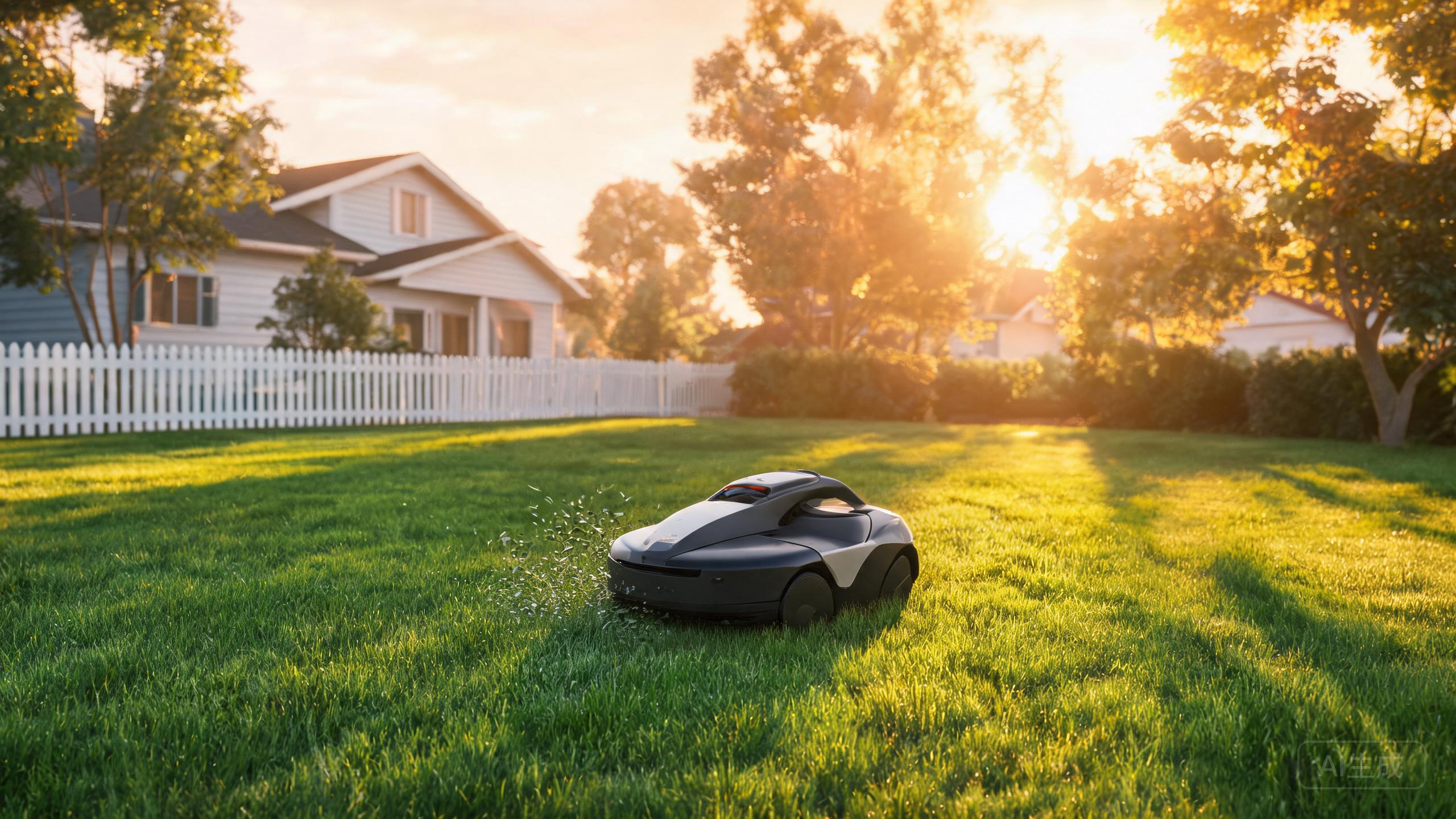
Most robotic mower coverage focuses on headline features, but the Anthbot M9 deserves a closer look at the engineering underneath. This deep dive examines the navigation stack, the wire-free perimeter approach, and the practical limits that explain its 7.8 rating. If you are comparing machines for a compact lawn and want to understand what full-band RTK plus vision actually delivers, this technical breakdown covers the details that matter.
Full-Band RTK + Vision: What the Navigation Stack Actually Does
The M9 pairs full-band RTK with a vision system, a combination rarely seen at its budget price tier. RTK provides centimeter-level positioning by correcting satellite signals against a fixed reference, while the vision layer adds local obstacle and boundary awareness when satellite geometry is weak. This matters in the RTK vs GPS robotic mower debate: plain GPS drifts by meters, but full-band RTK narrows that to a few centimeters. The vision component acts as a fallback, helping the mower hold its path near hedges, walls, and garden furniture where sky view is partially blocked. For a wireless robotic mower review, that redundancy is the most interesting technical story here.
Wire-Free Perimeter: How the M9 Eliminates Installation Work
The spec sheet lists no perimeter wire, which is the M9's biggest practical departure from traditional installations. Conventional robotic lawn mower installation requires burying or pegging hundreds of meters of boundary cable, a job that can take a full weekend on a small lawn. The M9 instead relies on its RTK and vision stack to define the working area digitally. In practice, this means you map the lawn once, and the mower references that virtual boundary on every subsequent run. The trade-off is that virtual boundaries depend on consistent satellite reception, so heavily shaded or walled-in yards may need more careful setup. For anyone searching for a robotic lawn mower installation that avoids trenching, this is the core selling point.
Coverage Limits and Slope Behavior: Where the M9 Fits
Anthbot positions the M9 for small yards, and the coverage ceiling is the clearest reason it lands at 7.8 rather than higher. A compact body and budget motor set mean it is not aimed at the best robot mower for large lawn duties; buyers with half-acre plots should look elsewhere. On slopes, the M9's capability is bounded by its traction and navigation confidence, so it suits gentle to moderate gradients rather than extreme inclines. If your property includes severe terrain, a dedicated robotic mower for steep slopes with more aggressive tires and higher torque will serve you better. The M9's value proposition is narrow but honest: a tidy, flat-to-mildly-sloped small lawn handled without wiring.
Feature Set and the 2026 Ranking Context
The cons list is short but telling: small coverage and fewer premium features. There is no mention of multi-zone management, advanced scheduling, or high-end sensors beyond the RTK and vision core. That is consistent with a budget tier, and it is why the M9 appears in budget-focused conversations rather than premium roundups. In the broader best robotic lawn mower 2026 landscape, the M9 competes on price and wire-free convenience, not on raw capability. Buyers who value a low entry cost and simple setup over maximum area coverage will find the trade-off reasonable. Those who need large-lawn endurance or steep-slope traction should treat the M9 as a starting reference point, not the final answer.
Our verdict
The Anthbot M9 is a technically interesting budget machine: full-band RTK plus vision, no perimeter wire, and a clear small-yard focus. Its 7.8 rating reflects real limits in coverage and premium features, but for compact lawns the navigation stack punches above its price. If your yard is small and wiring is the obstacle, the M9 is worth a serious look.