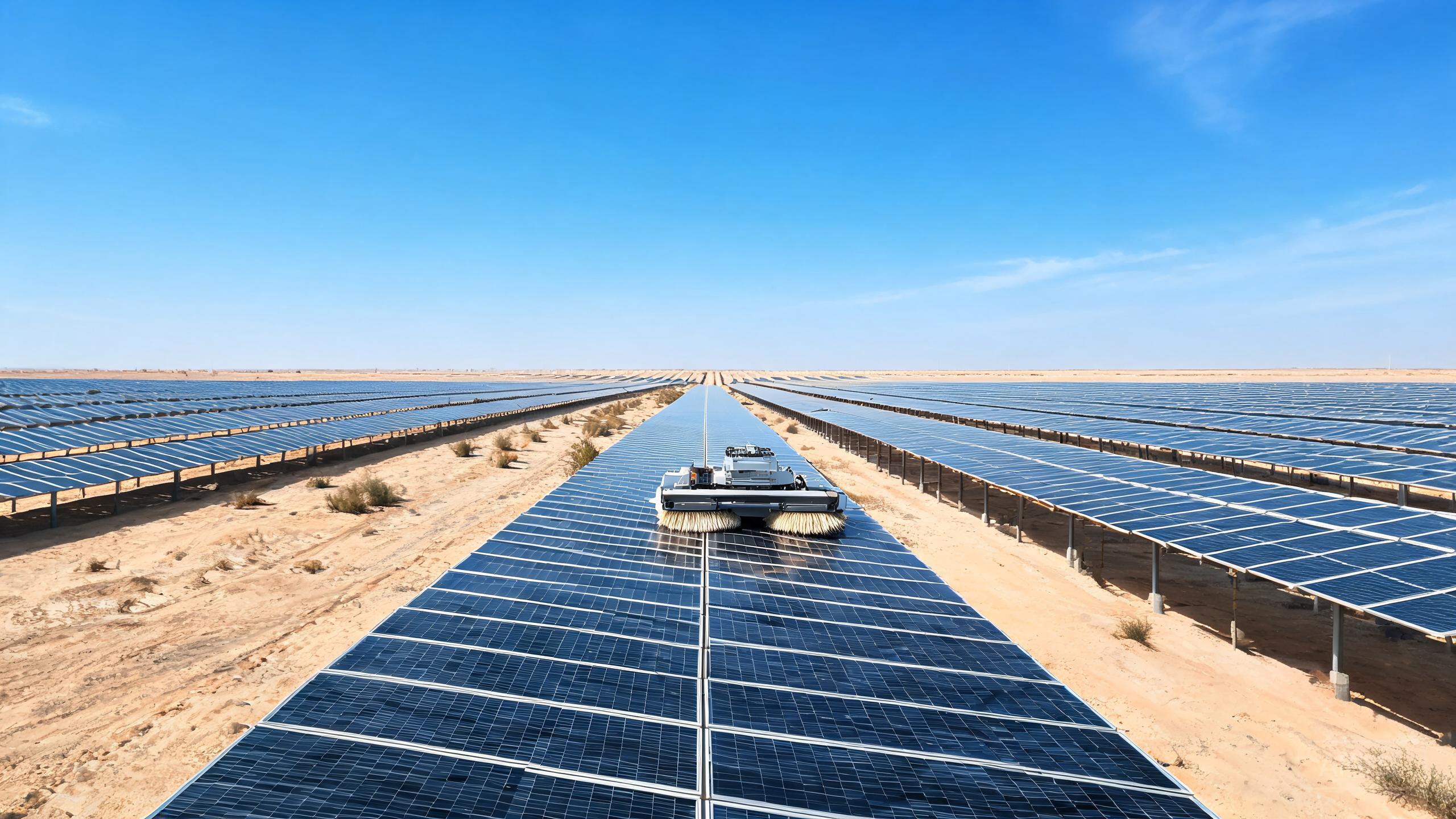
Coverage rate is the single number that decides whether a cleaning robot pays for itself. A machine that cleans 95% of a row in one pass but needs three passes per day is worse than a slower unit that finishes the array before the sun peaks. This editorial breaks down how coverage rates actually work across the best solar panel cleaning robot 2026 lineup, where waterless and wet systems diverge, and how solar panel cleaning robot cost tracks real throughput rather than headline specs.
What Coverage Rate Really Means
Coverage rate describes the share of panel surface a robot treats in a single pass, but vendors report it differently. Some quote brush width multiplied by travel speed; others count only the area actually contacted by the cleaning head. For a utility scale PV cleaning robot, the meaningful figure is hectares or megawatts cleaned per hour, including repositioning between rows. Ecoppia T4 (9.5) is built around waterless, utility-scale coverage with minimal repositioning overhead, while SolarCleano F1 (9.0) trades raw width for remote-controlled precision on mixed arrays. When you compare quotes, ask for throughput per shift rather than a percentage — that is the number that maps to labor savings.
Dry vs Wet Solar Panel Cleaning and Coverage Trade-offs
Dry vs wet solar panel cleaning changes coverage math considerably. A waterless solar panel cleaner such as the IFBOT X3 (8.8), rated best for steep roofs and dry cleaning, avoids water logistics entirely and can run tighter row spacing, but dust bonding in humid climates may require repeat passes. Wet systems like the GEKKO Solar Fox (8.7) and Neexgent NXR-IV (8.5) cover more stubborn soiling in one pass at the cost of tanks, hoses, and refill downtime. The SDZ NCE Fugo X1 (8.3) leans autonomous with long runtime, which helps sustained coverage on rooftop arrays. In practice, hybrid fleets often win: dry passes for routine dust, wet passes after long dry seasons.
Does Solar Panel Cleaning Improve Output Enough to Justify Cost?
Does solar panel cleaning improve output? Yes, but the gain depends on local soiling rates and how completely the robot covers each row. Partial coverage leaves streaks that create mismatch losses across strings, which is why a 90% coverage machine can underperform a slower 98% unit. Solar panel cleaning robot cost ranges widely: budget OEM options like the Lovsun PV Cleaner Robot (7.5) and the CE-certified TEAMANTS TAR01 (7.2) lower entry barriers, while utility-grade platforms command far more and are justified only at scale. The Tengda TT-1500 (7.0) and X8 Robotics X8 Plus (6.8) suit niche use cases — RV panels and tracked ground plants respectively — where full-array coverage is less critical than portability or terrain handling.
Matching Coverage Rates to Your Site
Start with array geometry. Long, uniform utility rows favor the Ecoppia T4's waterless architecture; fragmented commercial rooftops favor the SolarCleano F1's remote control. Steep pitches push you toward the IFBOT X3. For service fleets covering multiple sites, the GEKKO Solar Fox and Neexgent NXR-IV offer wet/dry flexibility with PLC control on the latter. Budget-limited residential installs can start with the Lovsun or TEAMANTS units and upgrade as soiling losses become measurable. Whatever the shortlist, verify coverage claims against a monitored trial block before committing a full fleet.
Our verdict
Coverage rate is not a spec-sheet trophy — it is the bridge between cleaning method and financial return. Pair the right dry or wet approach with a robot whose real throughput matches your array geometry, and the output gains will justify the investment. Use the ratings above as a starting filter, then demand shift-level throughput data before you buy.