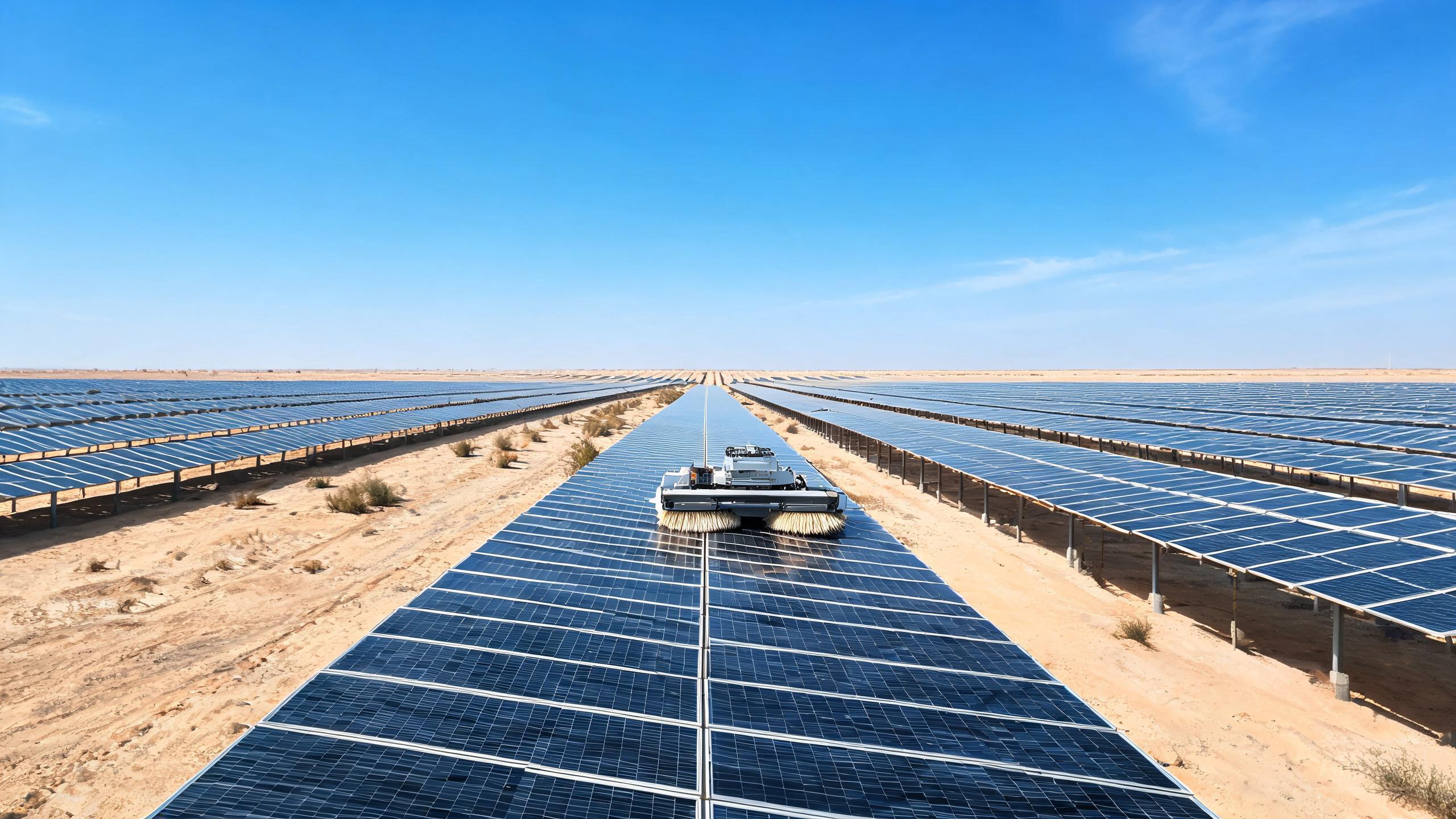
SDZ NCE has positioned its Fugo X1 as an autonomous rooftop cleaner with a seven-hour runtime, aimed at large residential and commercial arrays. Rather than re-running a standard review, this update looks at where the Fugo X1 fits in the bigger 2026 picture: the shift toward waterless solar panel cleaning, how dry vs wet solar panel cleaning decisions are made, and what buyers should weigh when comparing a utility scale PV cleaning robot with a rooftop-focused machine.
Why the Fugo X1's 7-Hour Runtime Matters for Waterless Cleaning
The Fugo X1's headline spec is its seven-hour runtime paired with fully autonomous operation on rooftops. In practice, that combination is what makes a waterless solar panel cleaner viable at scale. A dry brush system has no tank to refill and no water line to drag, so the only real constraint on a cleaning session is battery life. Seven hours changes the math: instead of stopping every hour or two, an installer or facility team can schedule a single pass that covers a large array and then walk away. For anyone asking does solar panel cleaning improve output, the answer depends heavily on frequency and consistency, and long-runtime autonomy is what makes consistent scheduling realistic on commercial rooftops where access is limited.
Dry vs Wet Solar Panel Cleaning: Where This Robot Sits
SDZ NCE lists the Fugo X1's dry focus as both a strength and a limitation. The upside is simplicity and speed on rooftops, where hauling water is expensive and sometimes impossible. The downside, noted in the product data, is that a dry-first design has limits against heavy grime such as bird droppings, caked dust after long dry seasons, or sticky agricultural residue. That is the classic dry vs wet solar panel cleaning trade-off. Dry cleaning wins on logistics, cost per pass, and autonomy; wet cleaning wins on stubborn soiling. For a rooftop array in a moderate-dust region, the Fugo X1's approach is usually enough. For heavy soiling, teams may need a periodic wet intervention alongside routine dry passes.
Rooftop Robot vs Utility Scale PV Cleaning Robot: Different Jobs
It is tempting to compare the Fugo X1 directly with a utility scale PV cleaning robot, but they solve different problems. Utility-scale machines are typically built for ground-mount rows, long travel paths, and very large daily coverage, often with water or microfibre systems. The Fugo X1 is explicitly a rooftop machine for large arrays, where navigation, weight, and safety on sloped or constrained surfaces matter more than raw hectares per day. If your site is a ground-mount solar farm, a utility-scale unit is the right category. If your site is a big commercial rooftop, the Fugo X1's autonomy and seven-hour runtime are the more relevant specs. Matching the machine class to the site is the single most important buying decision.
Solar Panel Cleaning Robot Cost and the Contact-Only Pricing Question
SDZ NCE does not publish list pricing for the Fugo X1, and the product data flags contact-only pricing as a drawback for buyers who want to compare options quickly. That is common in this category, but it makes solar panel cleaning robot cost planning harder. A practical way to frame the budget is to compare total cost per cleaning cycle: labour, water, access equipment, and downtime on one side, versus robot acquisition, charging, and maintenance on the other. Because the Fugo X1 runs seven hours per charge and needs low daily attention, its value case strengthens on arrays that would otherwise require repeated crew visits. When requesting a quote, ask about coverage per charge, spare parts, and service intervals so the comparison is apples to apples.
Our verdict
The Fugo X1 is not trying to be everything. It is a rooftop-focused, waterless-first autonomous cleaner with a seven-hour runtime, and that focus is exactly what makes it useful in a 2026 market where dry cleaning is becoming the default for routine maintenance. Pair it with occasional wet cleaning for stubborn soiling, match it to rooftop rather than ground-mount sites, and treat the quote conversation as a total-cost-per-cycle exercise. For installers who want set-and-forget roof maintenance, that combination is a sensible fit.