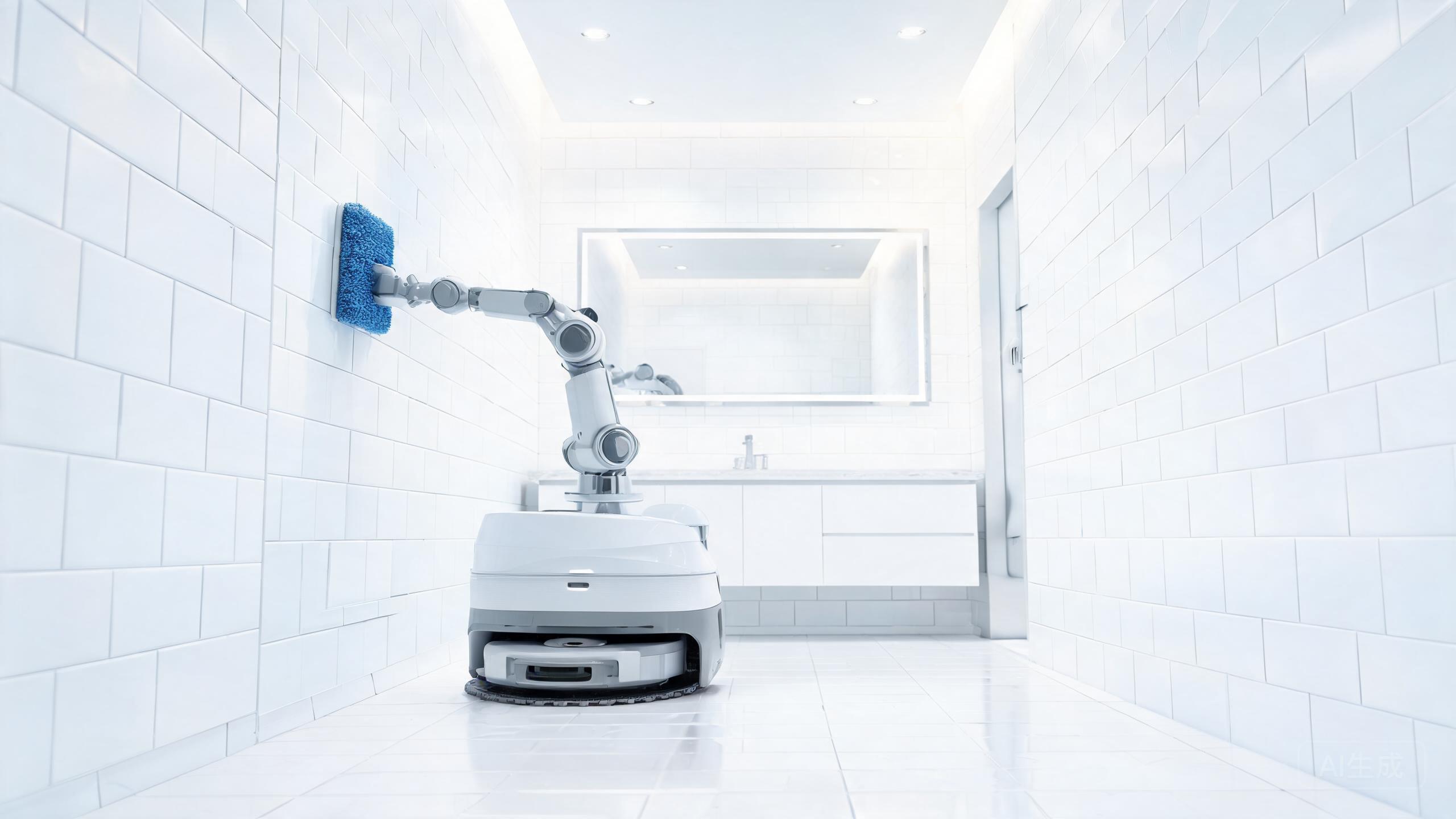
Restrooms are the hardest room in any facility to automate: tight spaces, fragile fixtures, and zero tolerance for missed contamination. That is why the robotic arm restroom cleaner has become the defining form factor of 2026. Instead of dragging a mop, a 6-axis arm can reach into bowls, around rims, and across sinks. This bathroom cleaning robot review ranks the leading autonomous toilet cleaning robot models and explains what commercial restroom cleaning automation really delivers.
Why the Robotic Arm Wins in 2026
Traditional scrubbers cannot clean a toilet bowl, and human crews cost more every year. A robotic arm restroom cleaner solves both problems: it deploys tools into three-dimensional spaces rather than sweeping flat floors. The Primech AI Hytron leads our ranking at 9.5 with a 6-axis arm paired with electrolyzed-water disinfection, meaning it cleans and sanitizes without harsh chemical refills. The HiveBotics Abluo Mark 2 follows at 9.0, adding LiDAR guidance so the same 6-axis bathroom cleaning approach navigates crowded restrooms reliably. Together these two define what buyers should expect from an autonomous toilet cleaning robot in 2026.
Full Ranking: From Hytron to the Pudu SH1
Third place goes to the Somatic BCR at 8.5, the generalist of the group: it handles toilets, floors, trash, and refills in one pass, which suits facilities that want one machine per restroom. The HiveBotics Abluo M1 at 8.0 remains a credible first-gen autonomous toilet cleaning option and a common entry point for pilots. The Pudu SH1 at 7.5 is not a toilet specialist but earns a place for multi-surface vertical cleaning with 80% water saving, useful in restrooms with large mirror and partition areas. For pure bowl-level work, the arm-based leaders remain unmatched.
Commercial Restroom Cleaning Automation and Cost
Deployment is simpler than skeptics assume. Commercial restroom cleaning automation typically starts with a single restroom mapped during off-hours, then scales by floor. Restroom robot cost is the main gating factor: arm-equipped flagship units sit at the top of the market, while first-gen models like the Abluo M1 and multi-surface units like the SH1 lower the entry price. Budget for consumables, mapping, and staff training alongside the hardware. Facilities that pair an arm robot with a floor unit usually find the combined restroom robot cost easier to justify than replacing an entire crew at once.
What to Check Before You Buy
First, confirm the arm's reach and payload match your fixture geometry; a 6-axis arm is only useful if it can enter every bowl on site. Second, verify disinfection method: electrolyzed water, as on the Hytron, reduces chemical handling. Third, check navigation: LiDAR guidance on the Abluo Mark 2 matters in narrow, obstacle-heavy layouts. Fourth, ask whether the unit handles trash and refills, as the BCR does, or requires a human partner. Finally, request a trial period and measure water use, since the SH1's 80% saving shows efficiency varies widely across this category.
Our verdict
The best robotic arm toilet cleaner in 2026 is the Primech AI Hytron, with the HiveBotics Abluo Mark 2 the strongest alternative for complex layouts. The Somatic BCR suits all-in-one needs, the Abluo M1 is the sensible pilot choice, and the Pudu SH1 covers vertical surfaces efficiently. Match the machine to your fixtures, budget for total restroom robot cost, and pilot before scaling commercial restroom cleaning automation.