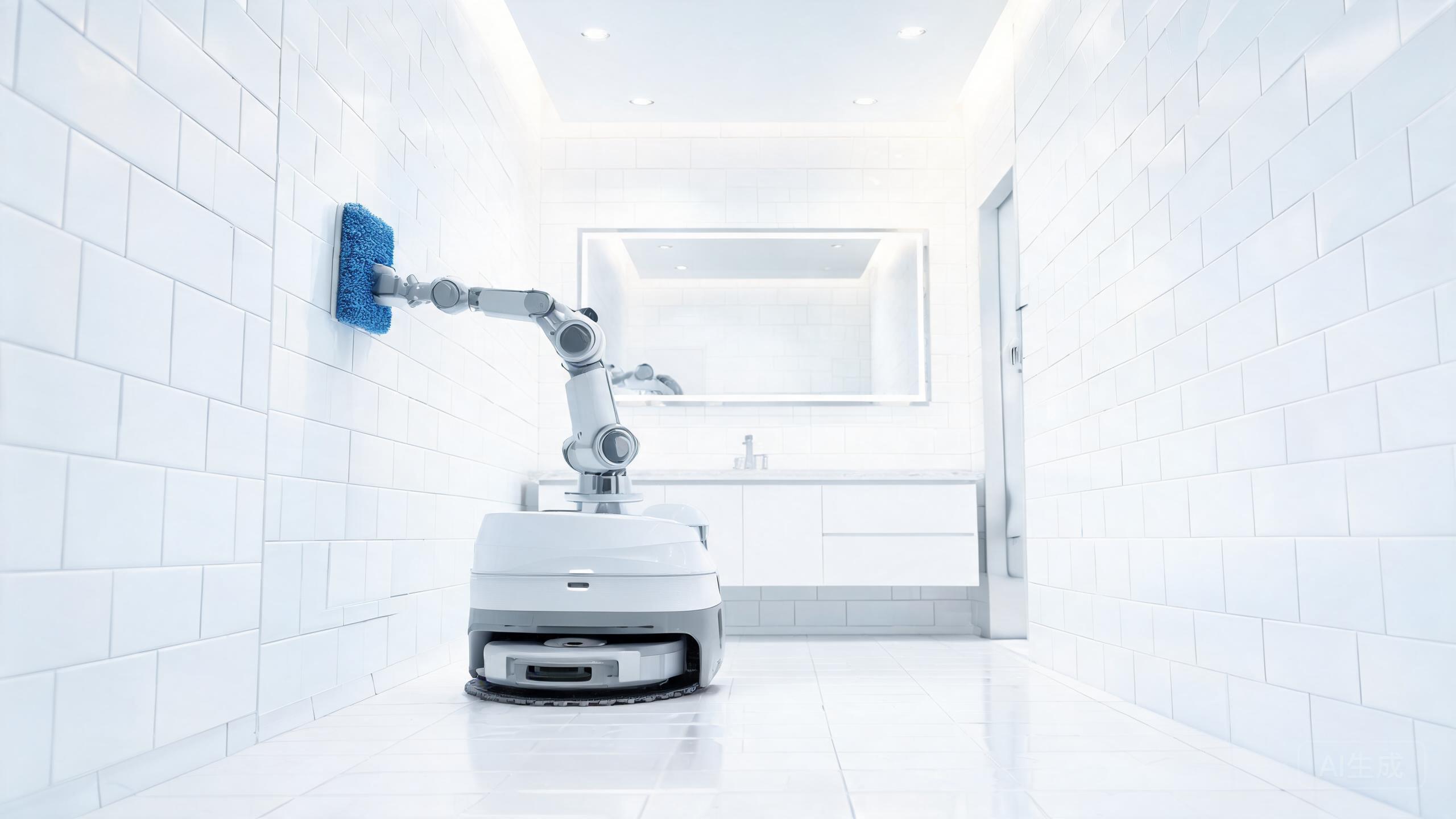
Most bathroom cleaning robot reviews in 2026 obsess over floor scrubbing and drain-toilet cycles. The Pudu SH1 takes a narrower but smarter path: it is built around vertical-surface cleaning across multiple fixtures, and it claims roughly 80% water savings versus manual methods. As an extension of Pudu's established service-robot line, the SH1 brings proven brand trust into a category where reliability is still rare. This review looks at where that vertical-first design wins, where it does not, and whether the restroom robot cost makes sense for your facility.
Why Vertical Surfaces Are the Real Battleground
Walk into any commercial restroom and the dirt tells a story: splash marks on walls, streaks down partition panels, residue on fixture faces. Floors get mopped, but vertical surfaces are usually wiped by hand on a best-effort schedule. The SH1's coverage is explicitly multi-surface with a vertical orientation, which means it targets exactly the layer of grime that manual crews skip when they are rushed. For facility managers evaluating commercial restroom cleaning automation, this is the gap worth closing first, because visible vertical grime drives complaints far more than a slightly dull floor.
The 80% Water Claim: Small Tank, Long Shifts
Water is the hidden cost of restroom cleaning. Every refill means a staff trip, a mop bucket, and downtime. Pudu rates the SH1 at 80% water saving, and that single number changes operational math: fewer refills per shift, less water hauled through corridors, and a smaller environmental footprint per cleaned square meter. In practice, that makes the SH1 less of a novelty and more of a shift-length tool. It pairs naturally with an autonomous toilet cleaning robot workflow, where the robot handles repeatable surface passes and staff focus on high-touch detail and restocking.
Brand Lineage Matters More Than Spec Sheets
The SH1's lineage is Pudu's service-robot line, and that is not marketing fluff. Restroom environments are unforgiving: humidity, tight turns, unpredictable obstacles, and staff who have no patience for a robot that needs babysitting. A vendor with an existing fleet of deployed service robots has already solved navigation, fleet software, and field service at scale. For buyers comparing a bathroom cleaning robot review to a purchase order, that track record lowers deployment risk more than any single spec. The trade-off is focus: the SH1 is optimized for vertical surfaces, so deep scrubbing of stubborn, caked-on stains is limited. Teams should treat it as a consistency layer, not a replacement for periodic deep cleaning.
Cost, ROI, and Where the SH1 Fits
Restroom robot cost is the question every procurement team asks, and the honest answer is that the SH1's value scales with restroom traffic and cleaning frequency. In a high-traffic venue, the 80% water saving and multi-surface vertical coverage translate into measurable labor reallocation: staff move from repetitive wiping to inspection and detail work. In a low-traffic office with two restrooms, the payback is slower and the robot may be overkill. The strongest fit is facilities that already run commercial restroom cleaning automation on floors and want to extend that consistency upward onto walls, partitions, and fixtures without adding headcount.
Our verdict
The Pudu SH1 is not trying to be every robot for every restroom. It is a vertical-surface specialist with an 80% water-saving claim, backed by a brand that already knows how to deploy service robots at scale. If your pain point is inconsistent wiping of walls, partitions, and fixture faces, this is one of the more sensible entries in the 2026 restroom cleaning robot market. If your pain point is caked-on grime, budget for a deep-cleaning partner alongside it. Rated 7.5/10: focused, credible, and honest about its limits.