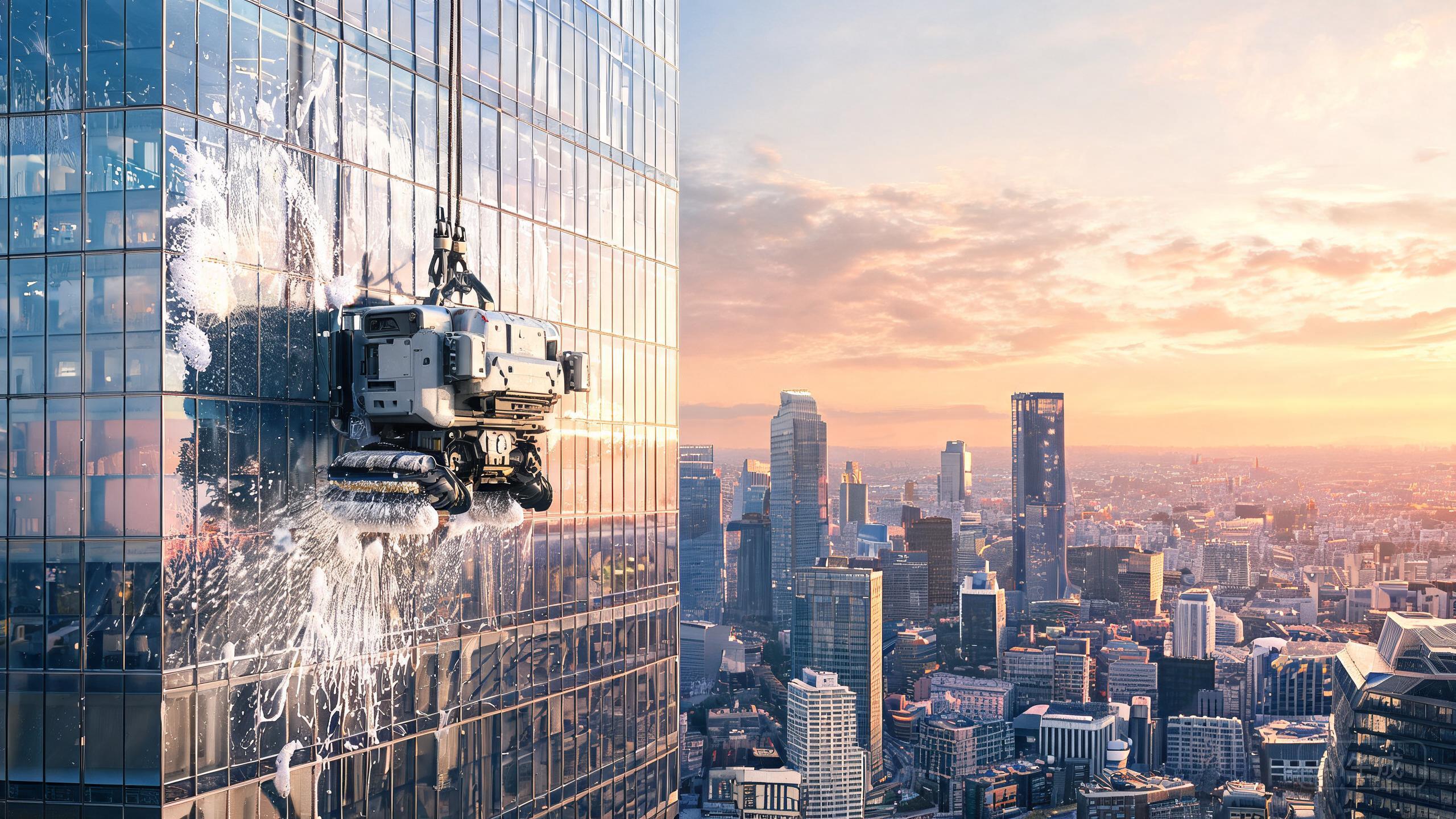
KUKA's KR AGILUS is not a cleaner you buy off the shelf. It is the compact industrial robot arm that sits inside Skyline's Ozmo, and that role makes it one of the more interesting entries in any building facade cleaning robot review for 2026. Our latest company and product news update looks at what the KR AGILUS actually contributes to facade cleaning robot 2026 discussions, where it fits in robotic facade cleaning vs rope access, and why integration matters more than raw specs.
What the KR AGILUS Actually Is
The KR AGILUS is a KUKA industrial robot arm in a compact form. In the facade cleaning world, its best-known identity is as the manipulator inside Ozmo, Skyline's window cleaning system. It is not a standalone cleaner, and KUKA does not market it as one. Instead, it brings proven industrial repeatability and payload handling to window-washing tasks. For anyone following high rise facade cleaning automation, that distinction matters: the KR AGILUS is the muscle, while Ozmo is the complete platform. Our rating of 7.2 reflects strong hardware with a narrow, integration-dependent use case.
Why It Matters for Robotic Facade Cleaning vs Rope Access
The core argument for robotic facade cleaning vs rope access is consistency. A human on a rope delivers variable pressure, variable coverage and variable safety exposure. An industrial arm like the KR AGILUS is built for repeatable motion, which is exactly what large glass surfaces need. In the Ozmo configuration, the arm handles the manipulator role while the platform manages adhesion, navigation and water delivery. That division of labor is why high rise facade cleaning automation is moving from concept to deployment. It also explains why a glass facade cleaning robot cost figure is rarely just about the arm: the arm is one proven component inside a larger, integrated system.
Ozmo Window Cleaning Robot: Where the Arm Earns Its Place
The Ozmo window cleaning robot is the product most readers will actually encounter, and the KR AGILUS is its arm. Pros are clear: a proven industrial arm, compact footprint and direct integration into a working system. Cons are equally clear: it is not a standalone cleaner and it requires integration to do anything at all. If you are comparing options in a building facade cleaning robot review, treat the KR AGILUS as a component score, not a full-machine score. Its 7.2 rating reflects that nuance. Buyers evaluating glass facade cleaning robot cost should ask about the whole Ozmo platform, service model and site suitability, not just the arm's spec sheet.
2026 Outlook for Facade Cleaning Automation
As we move through 2026, facade cleaning robot 2026 coverage will increasingly focus on integrated platforms rather than isolated hardware. The KR AGILUS shows the pattern: an established industrial arm becomes relevant to cleaning only when a company like Skyline builds a complete system around it. That is good news for high rise facade cleaning automation, because it means the reliability question is partly already answered by industrial robotics. It is also a caution for buyers who expect a single purchase to solve facade cleaning. The KR AGILUS is a strong arm inside a strong system, and that is the honest way to read it.
Our verdict
The KUKA KR AGILUS earns a 7.2 in our books because it is a proven industrial arm doing real work inside the Ozmo window cleaning robot. It is not a standalone cleaner, and it should never be reviewed as one. For buyers tracking facade cleaning robot 2026 developments, the lesson is to evaluate complete platforms, not isolated components. If you want the arm, you are really shopping for the system around it.