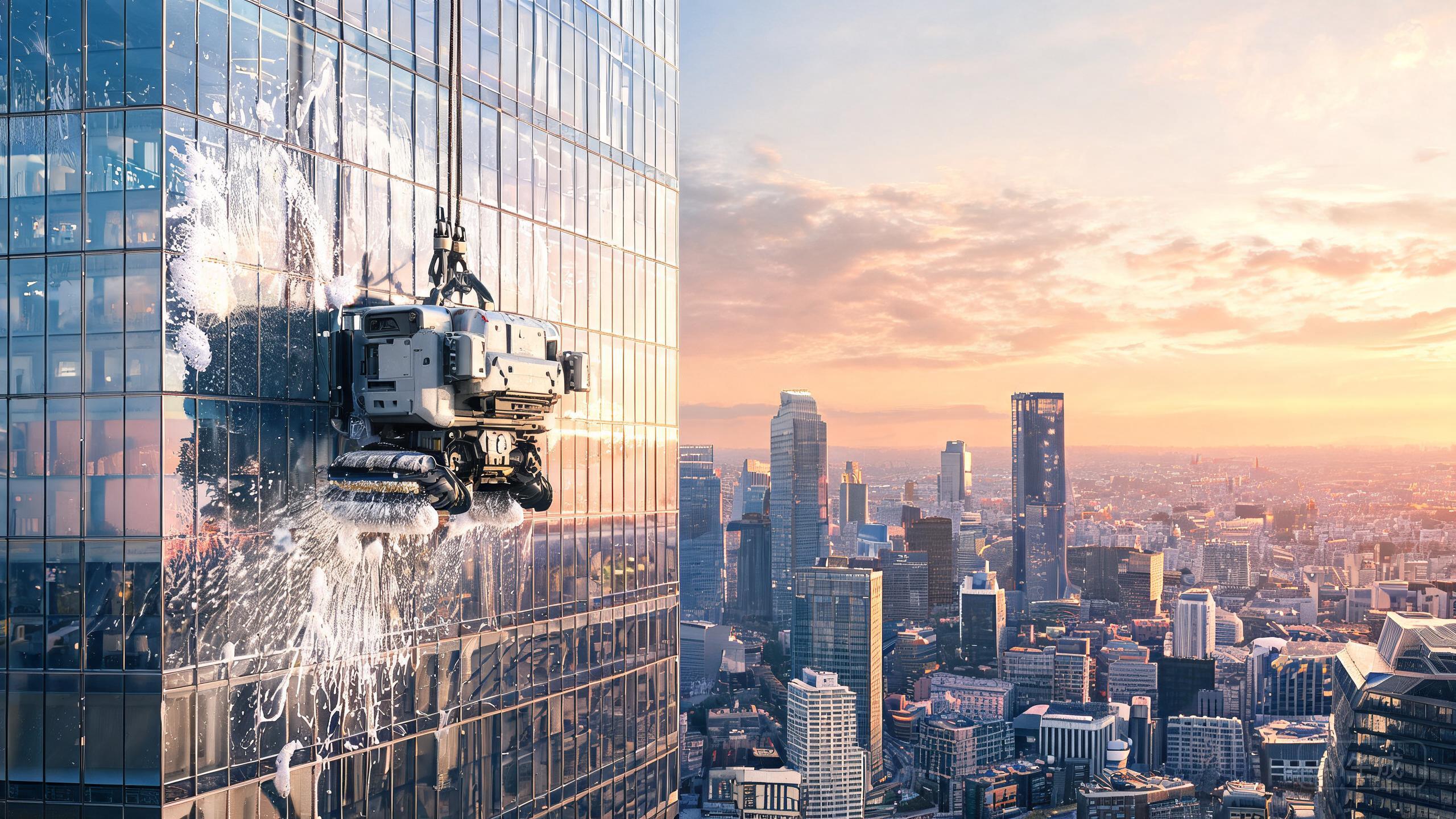
The Kite Robotics Kite arrives in 2026 as a climbing facade cleaning robot built for one of the hardest jobs in high-rise maintenance: reaching the top of landmark towers without putting people on ropes. With a rated maximum height of 200 m, it targets glass and complex facades rather than only flat curtain walls. In this building facade cleaning robot review, we break down what the Kite does well, where it slows down, and how it fits into the broader shift toward high rise facade cleaning automation. If you have been comparing robotic facade cleaning vs rope access or wondering how a glass facade cleaning robot cost pencils out on a tall, geometrically tricky building, the Kite is one of the most interesting machines to evaluate this year.
Kite Robotics Kite: What It Is and Who It's For
The Kite is a climbing robot focused on landmark and complex towers. Its headline spec is a 200 m maximum height, and its target surfaces are glass plus complex facades, not just uniform glass panels. That combination matters. Most facade robots are optimized for flat, repetitive grids; the Kite is positioned for buildings where conventional rigs struggle to reach. The manufacturer's own verdict frames it as a fit for intricate structures, which is exactly where high rise facade cleaning automation has been weakest. If your portfolio includes towers with fins, mullions, setbacks, or mixed cladding, the Kite is aimed at you. If you only own simple flat glass boxes, its strengths will be partly wasted.
Performance, Coverage, and the 200 m Climb
The Kite's locomotion is climbing, which is what enables the 200 m reach without a crane or suspended platform. In practice, that reach changes project planning: a single machine can cover zones that would otherwise need multiple rope drops or a mast climber. The trade-off is speed. On simple flat glass, the Kite is slower than machines purpose-built for large uniform panels. Its value shows up on complex geometry, where slower but continuous coverage beats fast machines that cannot access the surface at all. For a glass facade cleaning robot cost analysis, this is the key nuance: the Kite's price should be judged against the cost of rope access crews, scaffolding, or boom lifts on buildings that are awkward to reach, not against the cheapest flat-glass robot on the market.
Robotic Facade Cleaning vs Rope Access: Where Kite Fits
The core argument for robotic facade cleaning vs rope access is risk and repeatability. Rope teams are flexible but exposed, and their throughput depends on weather and crew availability. The Kite removes the human from the drop line for cleaning passes, which simplifies safety planning on tall towers. It does not eliminate setup: the Kite requires project-specific setup, a con to weigh honestly. Each new building may need configuration before the robot can run productively. That makes the Kite a better fit for recurring contracts on the same landmark towers than for one-off jobs. For owners pursuing high rise facade cleaning automation across a portfolio, the math improves with repeat visits. For comparison shoppers, note that the Ozmo window cleaning robot serves a different, smaller-scale segment; the Kite is a facade-scale climbing platform, not a window-pane gadget.
Verdict: 8.5/10 for Complex, High Towers
We rate the Kite Robotics Kite 8.5/10. It earns points for its 200 m reach, its ability to handle complex structures, and its coverage of surfaces beyond plain glass. It loses points for project-specific setup and for being slower on simple flat glass. In a 2026 facade cleaning robot 2026 landscape that is still fragmented by surface type and building shape, the Kite occupies a clear niche: landmark and complex towers where access, not speed, is the bottleneck. If your building is tall, geometrically difficult, and cleaned on a recurring schedule, the Kite belongs on your shortlist. If it is a simple flat glass box, a specialized flat-panel robot will likely be faster and cheaper to run.
Our verdict
The Kite Robotics Kite is a focused machine rather than a universal one, and that focus is its strength. A 200 m climbing reach plus support for complex facades makes it a credible answer to high rise facade cleaning automation on buildings that rope crews and conventional rigs find hard to service. The caveats are real: project-specific setup and modest speed on plain flat glass. Weigh those against the alternative cost of rope access on awkward towers, and the Kite's 8.5/10 rating holds up. For landmark and complex towers in 2026, it is one of the more compelling facade cleaning robots to evaluate.