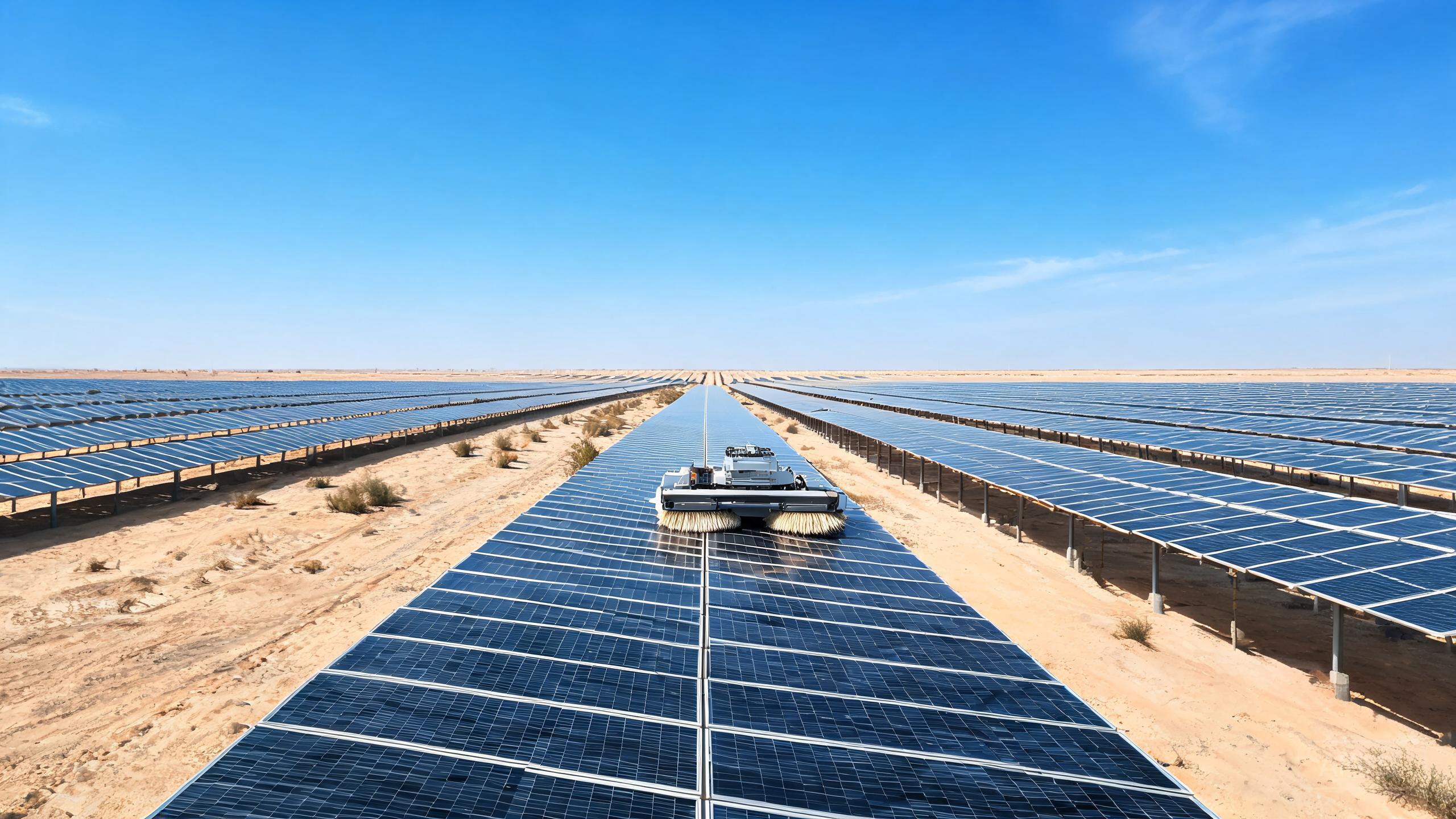
Most reviews of the IFBOT X3 stop at the headline: a dry-only robot for steep rooftops. This deep dive goes underneath that summary and reads the X3 as an engineering system. We examine what its four core specifications actually mean in the field, where the semi-autonomous dry brush architecture helps crews, and where a narrow per-pass width changes the math on a job. If you are comparing machines for a rooftop contract or building a shortlist of the best solar panel cleaning robot 2026 options, the specification sheet matters more than the marketing.
Dry Brush Method: What 'Dry Only' Means as a Specification
The X3 lists its cleaning method as dry only, and its cleaning tool as a dry brush. Those two lines are the most consequential on the sheet. A dry brush system has no water tank, no pump, no spray bar, and no runoff path, which removes the weight, plumbing, and drainage constraints that shape wet machines. For rooftop crews, that translates into a simpler deployment: no water logistics on the roof, no containment planning, and no residue management. The trade-off is stated plainly in the cons: the X3 is not built for heavy soiling. As a waterless solar panel cleaner, it targets the dust accumulation that dominates rooftops, not cemented grime. That makes the dry-only spec a deliberate design choice rather than a limitation to work around.
Semi-Autonomous Operation and the Steep-Slope Application
Autonomy is specified as semi-autonomous, and the application field reads rooftop / steep slopes. Read together, these two specs describe a machine that is guided rather than fully self-directed, which suits sloped rooftops where edge conditions and panel layout vary. The steep-slope application is the X3's defining capability: it is engineered to stay on inclined surfaces where a general-purpose unit would be at risk. For teams weighing dry vs wet solar panel cleaning, the semi-autonomous, slope-rated combination is the practical argument. It lets a crew position the robot and supervise progress without committing to full autonomy, and it keeps the machine in the rooftop niche where dust is the main enemy. Note that the X3 is not positioned as a utility scale PV cleaning robot; its rooftop and steep-slope focus is a different job class entirely.
Narrow Per-Pass Width: The Coverage Math on a Rooftop Job
The cons list flags a narrow per-pass width, and this is the spec that most affects planning. Coverage per pass determines how many runs a robot needs across an array, and on a steep rooftop every extra run is time on an incline. A narrow width is not a defect in itself; it is a trade-off that comes with a compact, slope-capable body. The practical response is to scope the X3 to arrays where its footprint and slope handling matter more than raw throughput, and to factor the extra passes into labor estimates. This is where solar panel cleaning robot cost should be evaluated on a per-job basis rather than sticker price alone: a machine that deploys fast on a difficult roof can still win on total job time even with more passes.
Does Solar Panel Cleaning Improve Output? Reading the Spec Sheet Honestly
Buyers often ask does solar panel cleaning improve output, and the X3's specification sheet answers it indirectly. The machine targets dust accumulation, the primary soiling mechanism on rooftops, using a dry brush and no water. Output gains depend on local dust rates, tilt, and cleaning frequency, none of which are fixed specs. What the sheet does tell you is the operating envelope: dry-only cleaning, semi-autonomous control, rooftop and steep-slope application, and a dry brush tool. Within that envelope the X3 is a repeatable, low-logistics maintenance tool, and repeatable cleaning is what converts soiling losses into recovered output over a season. The honest read is that the X3 is built for consistent dry maintenance on difficult roofs, not for one-off deep restoration.
Our verdict
Read as a specification sheet rather than a slogan, the IFBOT X3 is coherent: a dry brush, semi-autonomous machine scoped to rooftops and steep slopes, with a narrow per-pass width as its known trade-off. That combination fits crews chasing reliable dry maintenance on difficult roofs, and it explains why the X3 keeps appearing on shortlists for the best solar panel cleaning robot 2026 in its niche. Match the specs to the job, price it per project, and the X3's engineering logic becomes clear.