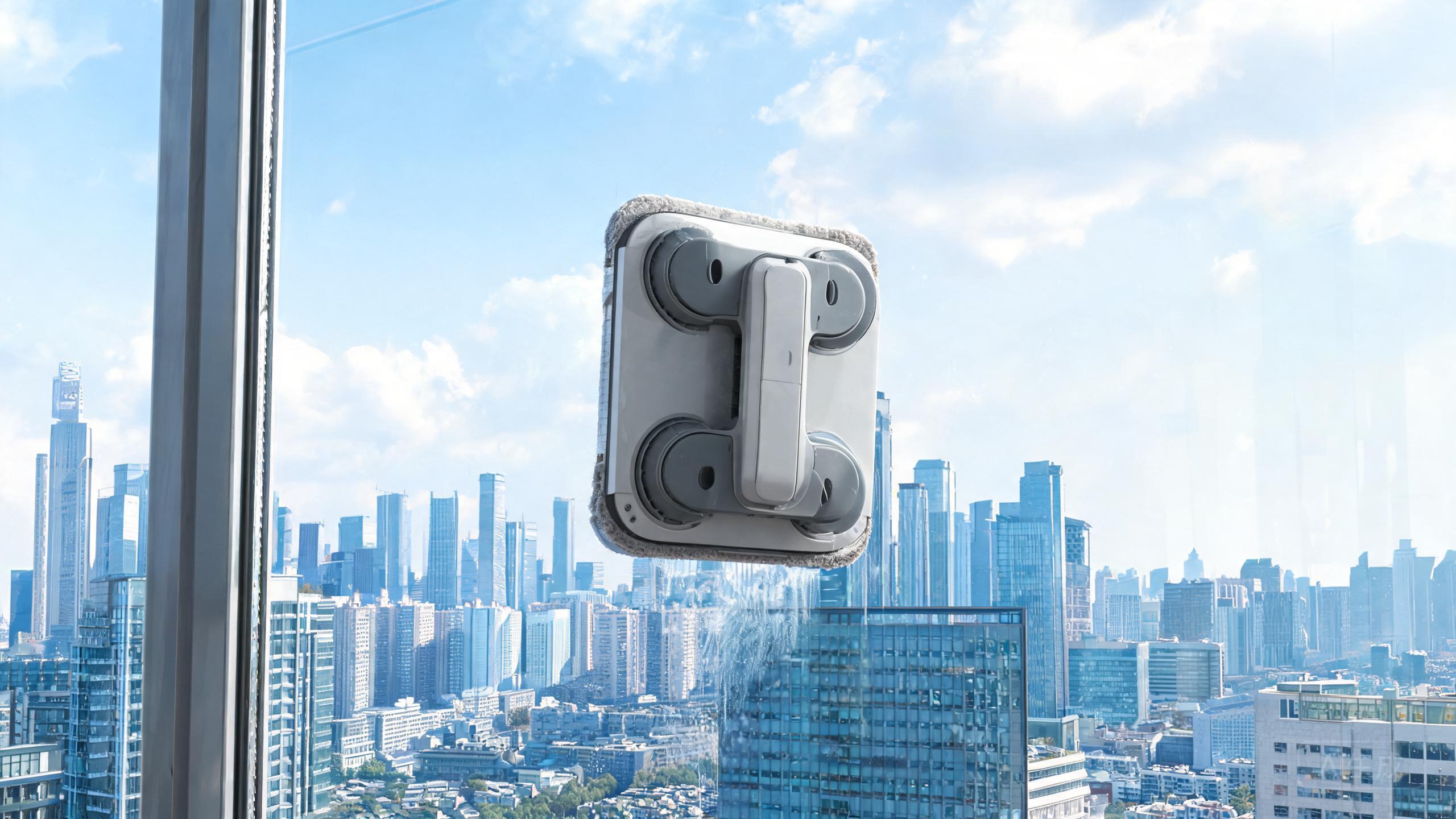
Most coverage of the HOBOT 268 focuses on whether it deserves a place in a 2026 shopping list. This deep dive takes a different route: it breaks down the machine's core engineering — vacuum adhesion, laser ranging, multi-surface operation, and corded power — and explains what each specification actually means in daily use. If you are weighing whether an automatic window washer is worth it, or comparing options for a best window cleaning robot 2026 shortlist, understanding the hardware underneath the marketing claims is the smartest place to start.
Vacuum Adhesion: How the Robot Stays on Glass
The HOBOT 268 relies on vacuum adhesion rather than magnets or tracks. A pump continuously evacuates air between the machine's base and the glass, creating negative pressure that holds the unit in place while it moves. This is the foundation of window cleaning robot safety: as long as the vacuum seal is maintained on a smooth, flat pane, the robot stays attached. Vacuum adhesion is also why the 268 can handle multiple surface types — glass, smooth tile, and similar non-porous materials — instead of being locked to windows alone. When people ask about window cleaner suction power, what they are really asking is whether the vacuum system can hold firmly through movement, turns, and edge detection. The 268's proven design has answered that question reliably for years, which is why it still earns a respectable 8.5 rating.
Laser Ranging and Edge Detection
Laser ranging is the 268's second key subsystem. Instead of relying only on bumper contacts, the robot uses laser measurement to sense its position relative to window edges and frame boundaries. This matters most on large panes and for anyone searching for the best robot for high rise windows: knowing where the glass ends helps the machine adjust its cleaning path and avoid running past the boundary. Combined with vacuum adhesion, laser ranging forms a two-layer approach to staying safe up high — one system holds the robot to the surface, the other helps it understand the surface's limits. It is a simpler architecture than the app-connected navigation found on newer models, but it is also the reason the 268 has remained a dependable performer in a robot window cleaner review focused on fundamentals rather than features.
Corded Power and Multi-Surface Operation
The 268 is a corded machine, which has practical consequences worth spelling out. Continuous mains power means no battery anxiety mid-cycle and consistent vacuum performance for the entire cleaning session — a meaningful advantage when you are cleaning large glass areas in one pass. The trade-off is a tether, so cable management and reach become part of planning each job. On the multi-surface front, the vacuum-plus-laser combination lets the robot work beyond windows: smooth shower glass, mirrors, and similar flat, non-porous surfaces are all fair game. That versatility is a large part of whether an automatic window washer is worth it for a given household — a machine that cleans several surface types earns its storage space more easily than a single-purpose device. The main caveat is age: the hardware is older and there are no modern app features, so scheduling, remote control, and detailed status reporting are simply not part of the package.
What the Specs Mean for Buyers in 2026
Read together, the 268's specifications describe a focused, mechanical approach to window cleaning: vacuum holds it on, laser keeps it aware of edges, corded power keeps it consistent, and multi-surface support broadens where it can be used. For a best window cleaning robot 2026 comparison, that profile suits buyers who prioritize proven reliability and straightforward operation over app ecosystems. It is less suited to anyone who expects scheduling, remote start, or smart-home integration. The absence of modern app features is the clearest reason the rating sits at 8.5 rather than higher. For high-rise use, the vacuum-and-laser pairing remains the relevant safety story, and buyers should treat the corded design as a feature to plan around rather than a flaw. In short: a mature tool with a clear job description, best matched to households that want dependable glass cleaning without connected extras.
Our verdict
The HOBOT 268 is best understood as an engineering-first window cleaner: vacuum adhesion for grip, laser ranging for boundary awareness, corded power for consistency, and multi-surface support for flexibility. Its older hardware and lack of app features are real limitations, but they do not erase what the core design does well. For shoppers who value proven mechanics and clear safety logic over connected conveniences, the 268 remains a sensible, well-understood choice in 2026.