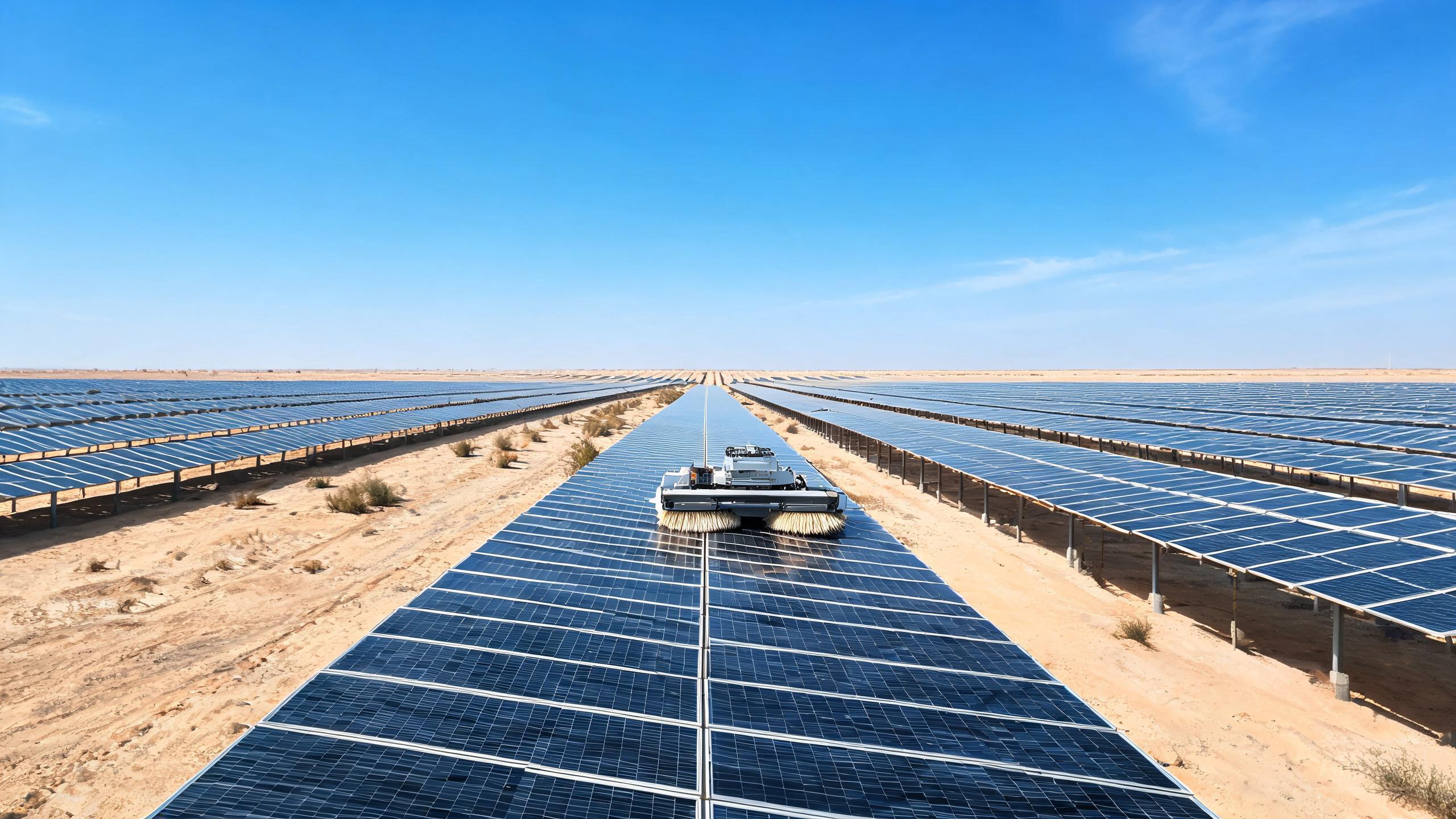
Most reviews of the GEKKO Solar Fox focus on its spec sheet. This one asks a different question: if you run an O&M crew that hits multiple solar sites every week, does the Fox actually earn its place on the truck? We look at it through the lens of a service business — deployment speed, dry vs wet solar panel cleaning, and the real-world math behind solar panel cleaning robot cost. If you are comparing the best solar panel cleaning robot 2026 options, this fleet-operator angle matters more than raw numbers.
Built for the Service Van, Not the Garage
The Fox is a remote-controlled, single-operator machine aimed squarely at service companies — not homeowners. That targeting shows in the workflow: one technician can unload, position, and run it, which keeps labor costs predictable on multi-site routes. As a utility scale PV cleaning robot, it is designed to move between jobs rather than live permanently on one array. For a fleet, that portability is the difference between quoting three sites a day and quoting one.
Dry vs Wet Solar Panel Cleaning: Why the Fox Carries Both
The Fox supports both wet and dry cleaning, which is unusual at this price-sensitive end of the market. In dry mode it works as a waterless solar panel cleaner — useful where water access is limited or where you want to avoid residue streaks. In wet mode it handles heavier soiling, like dust cemented by morning dew or agricultural fallout. The practical benefit for a service fleet is that one machine covers both contract types, so you are not turning down jobs because a site lacks a water point. That flexibility is central to the dry vs wet solar panel cleaning debate, and it is the Fox's strongest argument.
Does Solar Panel Cleaning Improve Output? The Fleet ROI View
Every service contract ultimately rests on one question: does solar panel cleaning improve output enough to justify the spend? Soiling losses vary by region, but the Fox's value proposition is not just the cleaning itself — it is the repeatability. A remote-controlled robot cleans at a consistent pace and pressure, which makes performance easier to guarantee across a portfolio. That consistency is what lets a service firm price contracts confidently and demonstrate output recovery to clients. When you stack that against solar panel cleaning robot cost, the calculation shifts from one-off purchase price to cost per site per visit — the number fleets actually manage.
Cost, Configuration, and the Training Question
The Fox's price spans a wide range because configurations differ — from basic to fully optioned — and that mirrors how fleets actually buy. A small operator may start with a simpler build, while a larger service company adds options that reduce labor per site. The trade-off is that operator training is expected; this is not a plug-and-play consumer gadget. Budget for onboarding, because a poorly trained operator erases the efficiency gains that make the robot worthwhile. If you are shortlisting the best solar panel cleaning robot 2026 for commercial work, factor training into the total cost, not just the invoice.
Our verdict
The GEKKO Solar Fox is not trying to win a spec war. It is trying to be the machine a service fleet can rely on across many sites, in both dry and wet conditions, with one operator. If your business model is multi-site O&M, that focus is exactly what you want. If you need a single-array set-and-forget device, look elsewhere. For professional crews weighing the best solar panel cleaning robot 2026 options, the Fox deserves a serious test drive — just budget for training and pick the configuration that matches your route density.