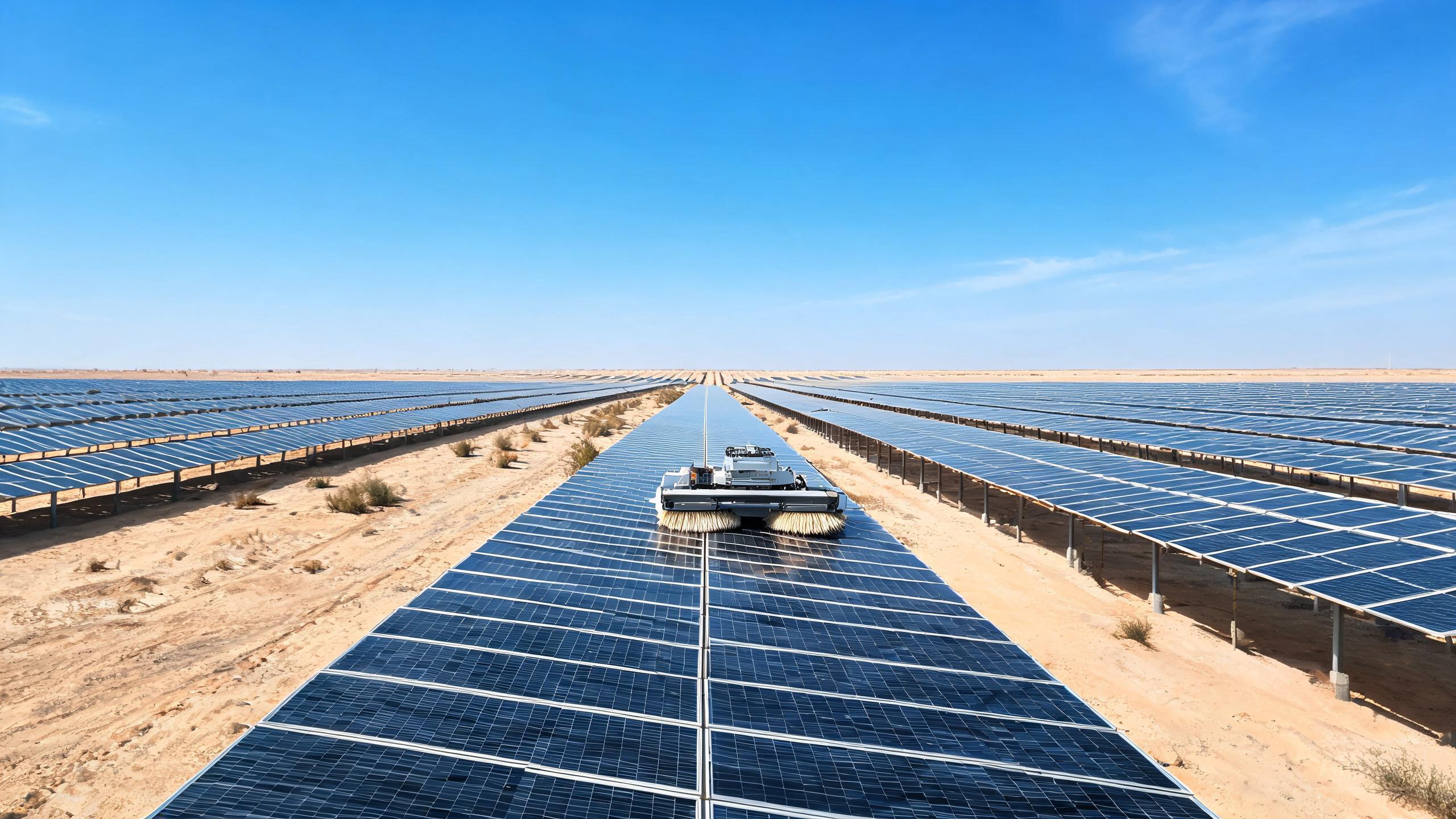
In the race to keep utility-scale solar arrays at peak efficiency, the Ecoppia T4 stands out as the best solar panel cleaning robot 2026 for arid, water-scarce regions. This fully autonomous, AI-driven system cleans photovoltaic panels without a single drop of water, making it a game-changer for large solar farms. In this review, we dive into its performance, cost considerations, and whether it truly answers the question: does solar panel cleaning improve output?
Waterless Innovation: Dry vs Wet Solar Panel Cleaning
The Ecoppia T4 is a prime example of dry vs wet solar panel cleaning done right. Traditional wet cleaning uses millions of gallons of water annually, which is costly and impractical in deserts. The T4 employs a waterless solar panel cleaner approach: microfiber rollers and air blowers remove dust and debris without water, reducing operational costs and environmental impact. This makes it the preferred choice for utility-scale PV cleaning robot applications in regions like the Middle East, Australia, and the US Southwest. Compared to wet methods, dry cleaning avoids water spotting and mineral residue, ensuring panels stay cleaner for longer.
AI-Driven Autonomy and Scalability
What sets the T4 apart is its advanced AI intelligence. The robot navigates entire solar fields autonomously, adapting to layout variations and scheduling cleanings based on soiling levels. This is crucial for utility-scale PV cleaning robot operations, where manual cleaning is labor-intensive and inconsistent. With proven global deployments across hundreds of plants, the T4 has become the benchmark for waterless care. Its AI ensures optimal cleaning cycles, directly addressing the concern: does solar panel cleaning improve output? Yes—by maintaining near-zero soiling losses, the T4 can boost energy yield by up to 15% in dusty environments, according to industry studies.
Cost Analysis: Solar Panel Cleaning Robot Cost
When evaluating solar panel cleaning robot cost, the T4 requires a significant upfront investment. It is contact-priced (quote-based) and designed for large installations, meaning it is not for small rooftops. However, the total cost of ownership is favorable for utility-scale projects. The waterless operation eliminates water procurement and treatment costs, reducing opex dramatically. Compared to manual cleaning or wet robotic systems, the T4 pays for itself within 2-4 years in most arid climates. For large solar farms, this makes it the best solar panel cleaning robot 2026 in terms of ROI.
Pros, Cons, and Deployment Considerations
Pros of the T4 include its fully waterless AI cleaning, built-for-utility-scale design, proven global deployments, and low water-usage opex. On the downside, it is contact-priced and requires large-scale installation, plus layout integration with the solar field's design. This means you need to plan for trackers, row spacing, and mounting systems. Despite these challenges, the T4's reliability and performance make it a top contender. For project managers wondering about 'does solar panel cleaning improve output,' the T4's data-driven approach ensures consistent cleaning, maximizing energy harvest.
Our verdict
The Ecoppia T4 is a top-tier utility scale PV cleaning robot that redefines solar panel maintenance. Its waterless, AI-driven approach is ideal for arid regions, and its global track record speaks volumes. While the solar panel cleaning robot cost may be high upfront, the long-term savings and output gains are undeniable. If you're seeking the best solar panel cleaning robot 2026 for large installations, the T4 is a clear winner.